
What is a digital night vision device?
A digital night vision device uses a light-sensitive sensor and a built-in infrared illuminator to show your surroundings on a screen – even in complete darkness where the naked eye sees nothing. Unlike classic light-amplifier technology, you can typically also record photos and video of what you see.
That makes digital night vision ideal for night-time wildlife observation, property surveillance, sailing and hunting preparation – at a far lower price than traditional night vision equipment.
Magnification: 8x or 16x?
Magnification is about how close you can get to your subject. An 8x model gives a wider field of view that is easier to hold steady, and suits observation at short and medium distances – in the garden, across a field or from a shelter.
A 16x model brings you twice as close and is the right choice when subjects are typically far away: deer on open fields, birds along a lakeshore or surveillance over longer distances. The trade-off is a narrower field of view and a more shake-sensitive image – a support or tripod is a good idea here.
- Choose 8x for mobile use and shorter distances.
- Choose 16x for stationary observation at long distances.
- Digital zoom beyond the optical magnification degrades the image – use it sparingly.
Infrared light and range
The infrared illuminator is the device's invisible flashlight – invisible to the eye, but visible to the sensor. The more powerful the IR light, the longer the range in complete darkness. Always check the stated range at 0 lux (total darkness), not just in faint moonlight.
Most models let you adjust the IR strength in steps. Turn it down at short distances – too much IR light up close overexposes the subject and washes out the detail.
Screen, recording and battery
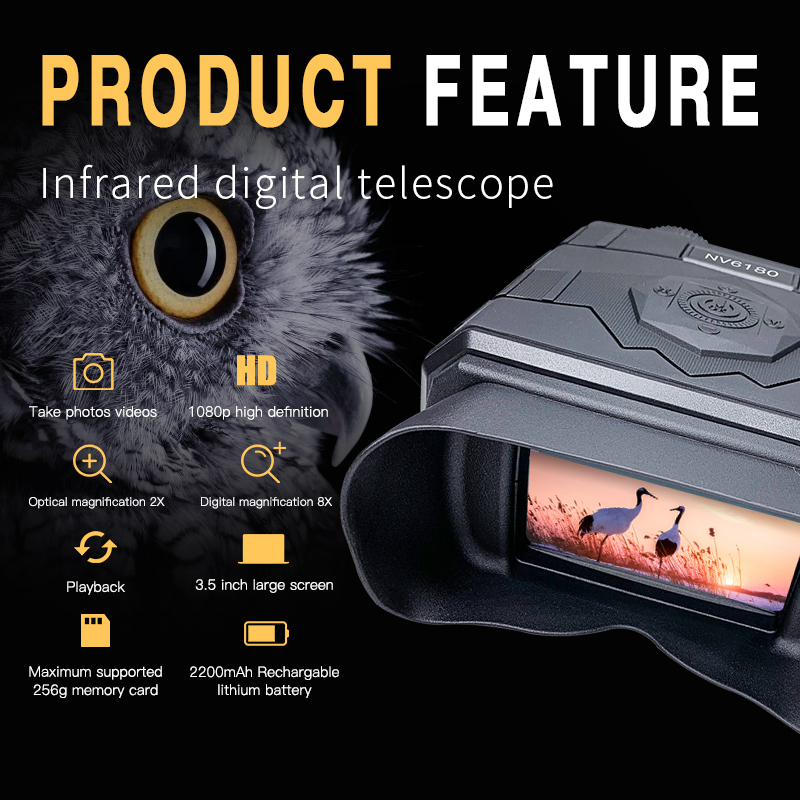
The screen is your biggest day-to-day experience. A large screen – for example 3.5 inches with a dual eyepiece – is far more comfortable during long observations because you look with both eyes instead of squinting with one.
If you want to document what you see, look for 1080p HD video, a photo function and room for a large memory card (up to 256 GB). A rechargeable lithium battery is cheaper to run than disposables, and on-device playback means you can review your recordings in the field.
Which model suits you?
Our 8x model is the versatile all-rounder for observing at short and medium distances with a steady, easy-to-read handheld image.
The 16x model is the long-distance specialist – the obvious choice for watching wildlife across open fields or monitoring larger areas.
The NV6180 with dual eyepiece and a 3.5 inch screen is the comfort choice: 2x optical and 8x digital magnification, 1080p recording and a relaxed two-eye view that makes it an easy first night vision purchase.
- Consider your typical observation distance – it decides the magnification.
- Prioritise screen size if you observe for long stretches at a time.
- Remember a memory card if you want to save photos and video.